

Your bareboat charter pre-departure checklist is the one thing standing between you and a stress-free week on the water. You've blocked the paid time off, booked the yacht, and rallied the crew.
Now it's go time.
But before you slip those dock lines, take 30 minutes to walk through every system onboard. This guide breaks it all down so you can find what you need in seconds, tick it off, and start sailing.
1. Check the Weather Forecast First
Before you touch anything on the boat, pull up the marine weather forecast for your route.
✔ Review wind speed, direction, and sea state for the next 24 to 48 hours
✔ In the BVI, watch for trade wind shifts and tropical weather systems
✔ In Croatia, look out for Bora and Maestral wind patterns along the Dalmatian Coast
✔ Screenshot the forecast and share it with your crew
✔ Adjust your passage plan if conditions look rough
Five minutes of weather prep can save you from a very long day, so don't skip it.
2. Hull and Deck Walkaround
Start with a slow lap around the boat. You're looking for anything that doesn't belong.
✔ Inspect the hull for cracks, gouges, or damage below the waterline
✔ Test all stanchions and lifelines for loose fittings
✔ Confirm the dinghy is properly secured and the outboard is locked down
✔ Look over deck hardware, cleats, and fairleads for wear
✔ Make sure fenders and dock lines are in good shape
3. Rigging and Steering Systems
A frayed halyard or a corroded turnbuckle might not look like much at the dock, but on open water, it can turn into a real problem. Give every connection a close look.
Standing rigging:
✔ Inspect shrouds, stays, and turnbuckles for wear or corrosion
✔ Confirm all split pins (cotter pins) are in place and taped
✔ Look up at the masthead for anything loose
Running rigging:
✔ Pull each halyard and sheet through its lead to check for chafing
✔ Confirm stopper knots (figure-eights) at the bitter ends of all sheets
✔ Run the main halyard up and down to test the sail track and batten cars
Steering:
✔ Turn the wheel lock to lock. Feel for grinding, clicking, or cable slack.
✔ Locate the emergency steering system and test-fit it on the rudder stock.
4. Anchor and Ground Tackle
You'll use your anchor almost every day on a bareboat charter. Make sure it's ready.
✔ Test the windlass, both up and down
✔ Confirm the anchor is secured but ready to deploy
✔ Trace the anchor rode to the bitter end and verify it's tied off to the boat
✔ Check the anchor chain for kinks or damage
✔ Know the anchorage depths on your chart for the first night
5. Engine and Mechanical Systems: The W.O.B.B.L.E. Check
Seasoned skippers run this five-minute routine every single time, so make sure to memorize it.
✔ W - Water: Check engine coolant. Clear the raw water strainer of seaweed or debris.
✔ O - Oil: Dip the engine oil and gearbox oil. Both should be at the right level and clear (not milky).
✔ B - Belts: Press the alternator and water pump belts. No more than half an inch of give.
✔ B - Bilge: Lift the floorboards. The bilge should be dry. Test both the automatic and manual bilge pumps.
✔ L - Look/Leaks: Scan the engine compartment for loose hoses, chafed wires, or any leaks.
✔ E - Exhaust: Start the engine. Check the stern for a steady flow of cooling water from the exhaust.
Fuel rule: One-third to get there, one-third to get back, one-third in reserve.
6. Safety Gear Checklist
Charter boats sit in marinas between trips, so equipment can expire, corrode, or go missing. Open every kit, check every gauge, and test every signal before you leave.
Life jackets (PFDs):
✔ One for every crew member, the right size, in good condition
✔ Whistles and lights attached to each one
Fire extinguishers:
✔ Gauge in the green on every extinguisher
✔ One near the galley, one near the engine, one in the cabins
Flares and signals:
✔ Verify expiration dates on all visual distress signals
✔ Test the air horn
Man overboard (MOB) kit:
✔ Locate the horseshoe buoy, MOB pole, and throw line on the stern pushpit
✔ Confirm everything is secure but easy to grab fast
First aid:
✔ Open the first aid kit. Check that it's fully stocked. Replace anything missing or expired.
Life raft:
✔ Verify the service date. If overdue, flag it with the charter base before you sign off.
7. Navigation Systems and Electronics
Your chartplotter is great until the screen goes black. Power everything up at the dock and confirm your analog backups are onboard.
✔ Check house battery bank voltage. Leave the dock with a full charge.
✔ Power up the chartplotter, depth sounder, and wind instruments
✔ Set the depth alarm for your yacht's draft
✔ Do a very high frequency (VHF) radio check on a working channel. Confirm you can transmit and receive.
✔ Make sure VHF Channel 16 is being monitored
✔ Locate the physical charts for your cruising area, plus parallel rule and dividers
Paper charts aren't optional. If your electronics die mid-voyage, you’ll have to rely on them.
8. Paperwork and Provisions
Missing paperwork can ground you before you even leave the marina, and some port authorities will ask for registration, permits, and proof of certification on the spot.
Make sure you have the following:
✔ Boat registration and charter paperwork
✔ Cruising permits (required in many Caribbean and European island waters)
✔ All crew passports stored in a dry bag
✔ Proof of sailing certification (most charter companies require ASA 104 or equivalent)
Prepare to Skipper Your Own Yacht with Sailing Virgins
Running through a bareboat charter pre-departure checklist is smart seamanship. But knowing what you're looking at and what to do when something goes wrong? That takes hands-on experience.
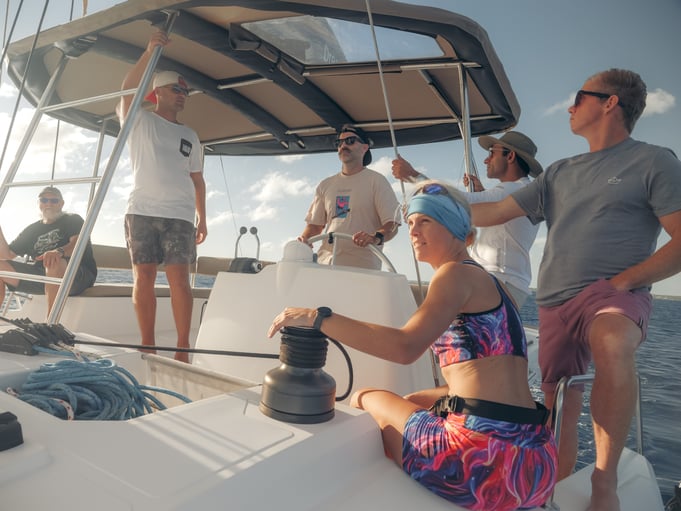
Sailing Virgins trains you on modern cruising yachts during a full week of liveaboard instruction.
You’ll get to handle lines, dock the boat, and make navigation decisions yourself under guidance from seasoned captains.
- Train in the British Virgin Islands or Croatia, earn ASA certifications up to 106, and add ASA 114 for catamaran endorsement.
- Complete ASA 104, and you can apply for your International Proficiency Certificate (IPC) for global chartering.
If you’re serious about chartering without second-guessing your decisions, review the Sailing Virgins schedule and book your training week.